

In this guide
In short
- Find the command word first. To what extent needs a judgement, not a description.
- Write your argument in a sentence or two before you plan any paragraphs.
- Note every source the moment you use it.
Step 1: Pull the question apart
Read it a few times. Mark the command word, the topic and any limits, like a date range or a named text.
Command words tell you what kind of answer they want. Describe is what it's like. Explain is why or how. Evaluate, assess and to what extent all mean weigh it up and reach a judgement. Compare is similarities and differences.
Take this one: To what extent was economic hardship the main cause of the French Revolution? You need a judgement, and economic hardship has to be weighed against other causes, not just described.
To what extent was economic hardship the main cause of the French Revolution?
Step 2: Dump what you know, then fill the gaps
Before reading anything new, get everything you already know onto a mind map. Question in the middle, factors as branches, evidence on the smaller branches. You usually know more than you think, and the gaps jump out.
Then go and fill them: class notes, set texts, the reading list, library books. Grab specific evidence, like a quote, a date or a figure from your textbook. And write down where it came from right away. Author, title, year, page.
Step 3: Decide your answer
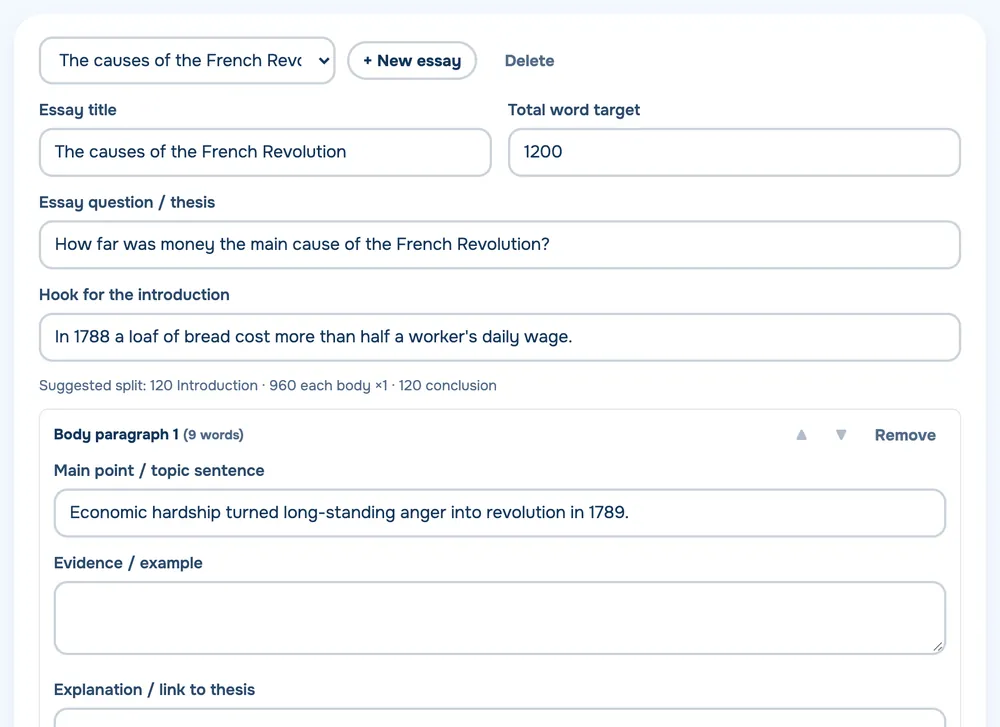
Write your thesis in a sentence or two. Every paragraph has to help prove it. For the French Revolution question, something like: economic hardship turned old resentment into a crisis, but without political and ideological causes it wouldn't have become a revolution.
If you can't write one yet, that's useful to know. It usually means you need a bit more research, or you haven't decided which factor matters most.
Step 4: Build the outline
One point per body paragraph. Point, evidence, explanation is a solid default: make the point, back it up, then link it to the question. Stick a rough word count next to each part so you don't run out of words before your best point.
- ~120
Introa line of context, key terms, your thesis.
- ~240
Paragraph 1the factor named in the question.
- ~540
Paragraphs 2 to 4the other factors, each linked back to the question.
- ~180
Counter-argumentthe best case against you, and why you still disagree.
- ~120
Conclusionyour final judgement. No new evidence.
Step 5: Reference as you go
Check which style your school wants (Harvard, APA, MLA, Chicago) and use it from day one. Quotes and paraphrases both need a citation. Changing the words doesn't make someone else's idea yours, and proper referencing is what protects you from accidental plagiarism.
Doing it on Brainlag
- Mind Map: question in the centre, one branch per factor.
- Essay Planner: add your thesis, then a section for the intro, each paragraph and the conclusion, with the point and evidence under each.
- Citation Generator: enter each source in your required style and copy it into your reference list.
- Before writing, read the outline top to bottom and check every paragraph actually answers the question.
Quick questions
How long should I spend planning?
In a timed exam, a few minutes of bullet points is worth it. For coursework, research and planning often take longer than the writing. That's normal.
Should I write the intro first?
Lots of people write it last, or do a rough one and redo it at the end. By then you know exactly what you're arguing.


