

In this guide
In short
- Rate every topic red, amber or green, and give the reds the most time.
- Keep about one slot in five empty for catching up.
- Name the task in every slot, not just the subject.
List your topics and rate them
Get the topic list for each subject from your syllabus or the exam board website. Next to each one: red if you barely know it, amber if you sort of do, green if you could answer a question on it right now. Be honest. This is what stops you revising the stuff you like and dodging the stuff that scares you.
Reds get the most sessions and go early, so you can come back to them. Ambers get a couple each. Greens just get a quick check with past questions.
- GeneticsRed3 sessions
- EcologyRed3 sessions
- CellsAmber2 sessions
- EnzymesAmber2 sessions
- RespirationGreen1 quick check
- PhotosynthesisGreen1 quick check
Count the time you actually have
Block out everything fixed first: school, travel, work, sport, family stuff, meals, sleep. What's left is your real revision time.
Be generous here. If you get home at 4 and need an hour to switch off, your first slot is 5. Two solid hours on a weeknight beats five you never do. Then keep roughly one slot in five as a buffer for being ill, a topic taking longer, or the birthday you forgot about.
Make every session specific
A block that just says Chemistry tells you nothing when you sit down. Chemistry: bonding, past paper questions on ionic and covalent bonds tells you exactly where to start.
Keep sessions to about 25 to 50 minutes on one topic, with breaks. Mix subjects across the week instead of doing all your maths on Monday. Coming back to a topic after a few days makes you work to recall it, and that's what helps it stick. So do questions or flashcards, not rereading.
- Put your hardest subject where your head's clearest.
- Come back to each red topic two or three times, a few days apart.
- Save the last few days before an exam for past papers, not new stuff.
Example: three subjects, three weeks
Biology, maths and English in three weeks. Two sessions on weeknights and four on weekend days gives you 18 a week. Keep 3 or 4 of those as buffers.
Week one goes mostly on reds, switching subjects between sessions. Week two, hit those reds again with past questions and start on the ambers. Week three is mainly timed past papers, and whatever goes wrong tells you what to look at again. If something turns out easier than you thought, swap it out. It's a plan, not a contract.
18 sessions a week, 3 kept free as buffers
With Brainlag
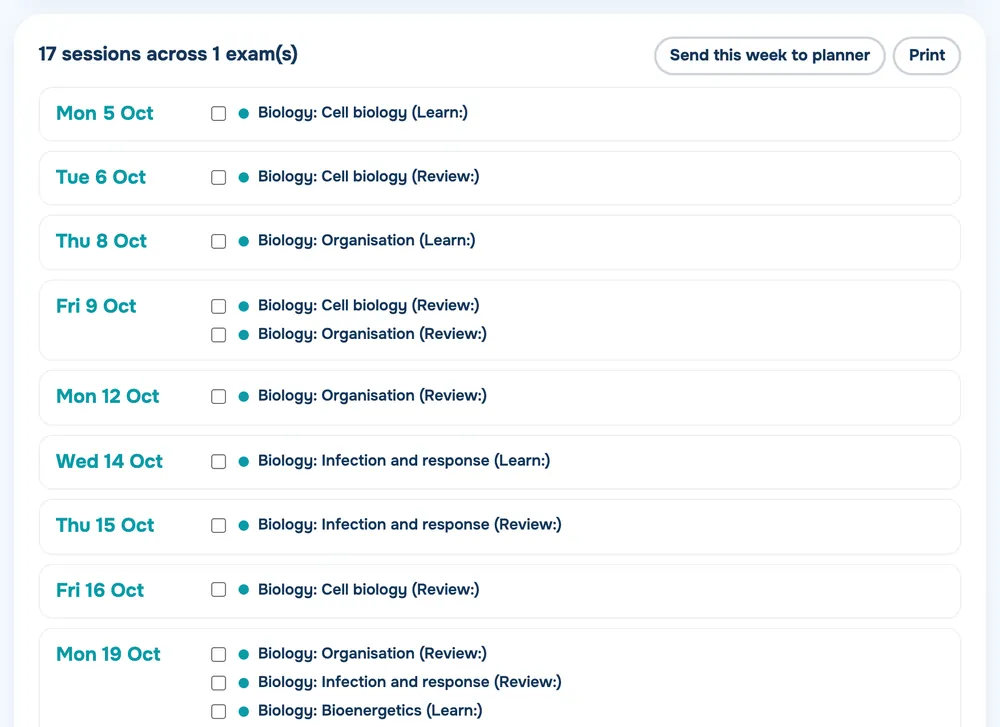
- Add each subject and its topics in the Revision Timetable, using your ratings, and set your exam dates.
- In the Weekly Planner, put your fixed commitments in first so you can see the real gaps.
- Fill the gaps with named blocks: subject, topic, task. Leave a few labelled Catch-up.
- At the end of each week, re-rate your topics and adjust.
When you slip
You will. Everyone does. Tick sessions off as you finish them, so you've got an honest record instead of a vague feeling of being behind. And protect your sleep. A slightly less ambitious plan you actually follow gets you further than a perfect one you abandon.
Quick questions
How many hours a day should I revise?
There's no single right number. A few focused sessions with breaks usually beat long stretches of tired rereading. Start with what you can keep up.
What if I've started late?
Prioritise red topics that are likely to come up, and do past paper questions. A short plan is still miles better than no plan.


