
Skip to content
Brainlag

Music Theory

Grade 7 Music Theory

Chromatic chords, suspensions, modulation and scores.

Lesson 1 is free. The full course comes with Brainlag Music.

  • Music Theory Grades 3 to 8
  • Ear training
  • Topic tests and mock papers

11 units, 52 lessons

Part way through? Find my level

Practise

Revise next

    How this works

    Picked from your answers on this device and your account: topics you are still learning, and secure ones you have not practised for a while. The bars show how sure you are on each one. It is not a grade.

    Mistakes

    All clear

    Lesson cards

    All decks

    Due today:

    Mixed practice

    10 questions across the course.

    Start mixed practice

    What you’ll be able to do

    • Spell the Neapolitan sixth in any key
    • Spell the augmented 6th above the flattened submediant
    • Recognise V of V and V7 of V in any position
    • Build the diminished seventh on the leading note
    • Name suspensions in minor keys
    • Name the key a passage ends in

    Units and lessons

    11 units, 52 lessons

    Review and exam preparation

    1. Unit 11: Exam preparation

      22 min with practiceBrainlag Music

    A look inside

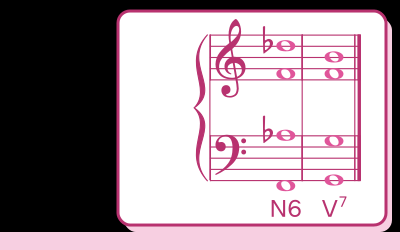
    The Neapolitan sixth

    A chord from outside the key

    D flat, F, A flat: major, on the flattened supertonic

    Every chord at Grade 6 used only the notes of the key (with the raised 7th in a minor key). Grade 7 adds chromatic chords: chords that borrow a note from outside the key for colour, and then lean strongly towards the dominant.

    The first is the Neapolitan sixth: the major chord built on the flattened supertonic.

    Open this lesson

    Alongside the lessons

    Music terms

    About this grade

    Chromatic harmony, suspensions and modulation, longer figured basses and melodies, and orchestral and chamber scores: Brainlag's own Grade 7 level course.

    Questions

    Which syllabus does it follow?

    Brainlag's own Grade 7 level course: the step after our Grade 6, in the same graded tradition of harmony, melody and analysis. It is not an exam board's syllabus, and its mock papers are our own.

    What is free?

    1 of the 52 lessons is free, and the first screen of every other lesson. Brainlag Music opens the rest and the topic tests.

    Do I need an account?

    Not for the free lesson. Brainlag Music needs one: sign in to open it, and your progress stays with your account on every device.

    How long does it take?

    About 10 hr of lessons in 11 units. Lessons take 10 to 14 minutes each.