

In this guide
In short
- Write less than you hear, in your own words. Copying slides isn't learning.
- Cornell notes come with a self-test built in.
- Mixing methods is fine. Outline in class, mind map later.
The outline method
Headings on the left, points indented underneath, details indented further. It's what most people do without thinking about it.
It's great when the lesson already has a clear shape, like a history lecture on three causes of a war. It falls apart when the teacher jumps around. If your outline ends up with lines linking everything to everything, try a map instead.
- Organelles
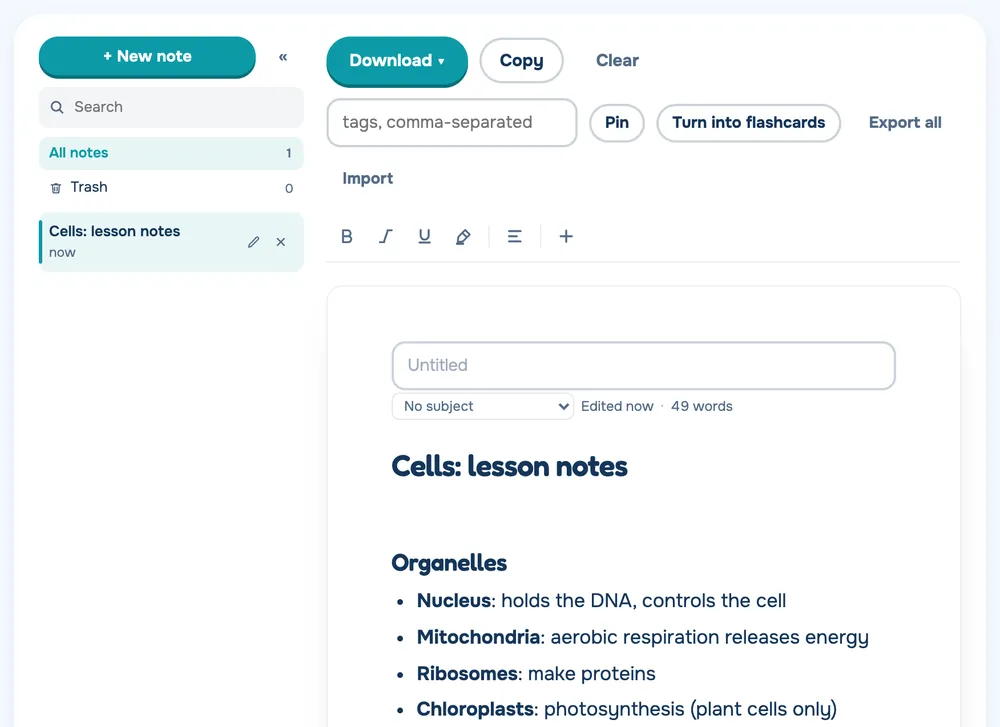
- Nucleus: holds the DNA
- Mitochondria: respiration
- Plant vs animal
- Plant: cell wall, chloroplasts
The Cornell method
Walter Pauk came up with this at Cornell University. Split the page into a wide right column for class notes, a narrow left column for cues and a strip along the bottom for a summary.
In class, write notes on the right however you like. Later that day, add questions or keywords on the left that your notes answer, then a two or three sentence summary at the bottom.
The payoff comes at revision time. Cover the right side, read the cues and answer from memory. You've basically built a quiz into your notes, which makes it a strong pick for anything you'll be examined on.
What does the nucleus do?
Where is energy released?
Nucleus: holds DNA, controls the cell
Mitochondria: aerobic respiration releases energy
Ribosomes: make proteins
Each organelle has one job; plant cells add a wall and chloroplasts.
Mind maps
Main topic in the middle, branches out to subtopics and details. Concept maps go a step further and label the links, like causes or is a type of.
They're ideal when everything connects: an ecosystem, the themes in a novel, the causes and effects of a revolution. They're hard to do live in a fast lecture though. Plenty of people take outline notes in class and turn them into a map afterwards, which is decent revision in itself.
Charts and the sentence method
When a lesson is basically a comparison, use a table. Rock types and how each one forms, or political parties and their policies, slot straight into rows and columns.
For fast, messy talks with no obvious structure, write each new idea as a numbered sentence. Not pretty, but it keeps up. Tidy it later.
In maths and science, worked examples beat any layout. Write each step with a quick note on why, so you can redo the problem later without looking.
| Rock | How it forms | Example |
|---|---|---|
| Igneous | Cooled magma or lava | Granite |
| Sedimentary | Layers pressed together | Sandstone |
| Metamorphic | Changed by heat and pressure | Marble |
Quick pick
- Clear, structured lesson: outline.
- Stuff you'll be tested on in detail: Cornell.
- Lots of connections, or reviewing a whole unit: mind map.
- Comparing things: chart.
- Total chaos: numbered sentences, tidied up later.
With Brainlag
Take outline notes in Notes during class. Afterwards, add a Questions section underneath plus a short Summary, and you've got Cornell. At the end of a unit, put the unit title in the centre of a Mind Map and add a branch for each main heading. When you revise, look only at the questions or the middle of the map and try to recall the rest before checking.
Quick questions
Hand or laptop?
Both work. What matters is summarising in your own words, which is easy to skip when you type fast. If you type, paraphrase on purpose and close the other tabs.
Should I rewrite my notes neatly?
Copying them out neatly is mostly presentation. Reworking them is different. Turning them into a map or writing cue questions makes you think again, and that's worth the time.


